Search Engine

Followers

Wednesday, April 14, 2010

Day 8: Trip to Japan (11 April 2010)


We have been scheduled to meet students from Yamaguchi University on this eighth day. The university is located in the Yamaguchi Prefecture in Japan's Chugoku region, with the city of Yamaguchi as its capital. This is perhaps the furthest place to the south-west that I would be in throughout this trip to Japan. Yamaguchi is already towards the southern tip of Honshu island. This part of Japan is well-known for fugu or pufferfish. I have been informed that one needs a license to remove the poison from this fish to ensure that the process is done properly.

We left Okayama by shinkansen heading from Okayama eki to Shin-Yamaguchi eki on board the Hikari Superexpress. There are only two stops between these two stations namely at Fukuyama and Hiroshima. The journey took exactly 1 hour 15 minutes covering a distance of 422 km.

When we arrived at Shin-Yamaguchi eki, we had to board a local train on the Ube line, alighting at an eki called Higashi-Shinkawa.
Throughout the local train journey, I got to see the rustic surroundings of rural Japan. The scenery was completely different from the busy metropolitans of Japan such as Tokyo and Osaka. Here, things look calm, serene and relaxing. Our destination, Higashi-Shinkawa eki, is located in - for lack of a better description - a small town. It is not quite a village, and not quite a big town.

We were met on arrival by the Malaysian students studying at Yamaguchi University. The students here have cars because public transportation is not as efficient or reliable as those found in big cities. After lunch, they took us around the towns located around the area. Initially we planned to return to Okayama earlier. But the students were very friendly and offered great hospitality that we decided to stay on for a little longer.
We took the local train to Shin Yamaguchi eki from another small eki, Maruo, before boarding the 18:21 shinkansen heading for Tokuyama eki on the Kodama Express. At this station, we changed to another shinkansen, this time the 18:51 Hikari Superexpress heading for Okayama eki. Again, the shinkansen made two brief stops at Hiroshima and Fukuyama. We arrived at Okayama at three minutes to eight in the evening.

On a personal note, I think that the Yamaguchi Prefecture is one of the most beautiful sites I have seen in Japan. Its rustic environment makes it all the more special. The place has its own charm. If there is one place that I would like to return to in Japan, it would be Yamaguchi.

Tuesday, April 13, 2010

Baggage handling at Narita

One of the things that impressed me upon arrival at Narita Airport could be seen at the baggage area. I am sure many of us are familiar with carousels that carry luggage or baggage of passengers who had just disembarked. So far, I have been to a number of airports - almost all airports in Malaysia, Padang in Indonesia, Rome in Italy, Cairo in Egypt, Algiers in Algeria, and Heathrow, Gatwick, Stansted, Glasgow, Belfast and Cardiff in the UK. But Narita (and perhaps all airports in Japan) impresses me the most.

Passengers' baggage are all neatly stacked and arranged in a uniformed manner on the carousel. It looks as if all the baggage are lining up neatly to be picked up by passengers. It's a small thing, I know. Nevertheless, I am impressed. The Japanese airport workers took the trouble of arranging the baggage neatly on the carousel, rather than just putting the baggage on the carousel haphazardly.

Not only does this make everything looks neat and proper, it also gives confidence to passengers that their baggage are handled with care, and not being thrown around as if they were not important.

Sometimes, it is these "small" things that give us some peace of mind.

Day 7: Trip to Japan (10 April 2010)

Another relatively quiet day actually. We decided to visit Hiroshima, the capital of Hiroshima Prefecture. I am pretty sure everyone knows about Hiroshima. Thus far, I have only read about the city. A few months back, there was an exhibition held at the Museum of Asian Art of Universiti Malaya on the atrocities of the atomic bomb that was dropped on 6th August 1945. That was as close as I got to Hiroshima, that is until today.

Again we boarded the Hikari Superexpress. This time we were heading from Okayama eki to Hiroshima eki. The distance is some 160 km, and the journey on the shinkansen took only 30 minutes. There was only one stop before Hiroshima, and that is Fukuyama.
Once reaching Hiroshima city, we took the Hiroden streetcar (picture above) towards the famous A-Bomb Dome. The remains of the building is now the a UNESCO World Heritage site. The atomic bomb was detonated some 600 metres above the building. Miraculously, the structure of the building and in particular, the building's dome, remain intact in spite of the huge blast of energy from the atomic bomb detonation.
Frankly, I cannot begin to describe my feelings to be standing near the A-Bomb Dome (above). I tried to imagine what transpired that fateful day on 6th August 1945. Try as I might, I don't think I can possibly visualise the horrors of the incident. However, to my mind, what is more important is the lessons learnt from this incident. I can only hope that our generation will at least try to understand history so as not to repeat it all over again.

A short walk away from the A-Bomb Dome is the Hiroshima Peace Memorial Museum. These two are actually part and parcel of an area called the Hiroshima Peace Memorial Park Area. There are many monuments here, erected to preserve the memory of the devastation that took place in Hiroshima.

After spending nearly an hour there, we walked towards Hiroshima Castle which is located about 750 metres north of the A-Bomb Dome. The castle was our last stop before boarding a streetcar back to the eki to return to Okayama where we are stationed. All in all, the seventh day serves as a good reminder of history for me. I am fortunate to be able to step on the grounds of Hiroshima. At the very least, my appreciation towards the significance of the event that took place on 6th August 1945 is greater.

Day 6: Trip to Japan (9 April 2010)

Another travelling day. This time from Kyoto, the capital of Kyoto Prefecture to Okayama, the capital of Okayama Prefecture. The distance is approximately 220 km. Journey by road would have taken about three hours, but taking the shinkansen saves a lot of time. We boarded the 09:49 a.m. shinkansen (Hikari Superexpress) from Kyoto eki and we arrived at Okayama eki at 11:17 a.m. The total time taken on this shinkansen journey was 1 hour 18 minutes. The shinkansen stopped at five stations, namely Shin-Osaka, Shin-Kobe, Nishi-Akashi, Himeji and Aioi before reaching Okayama.
By the time we arrived, it was about half an hour before Friday prayer. We were met on arrival at Okayama eki by a PhD student at Okayama University of Science, Arief Mokhtar. He was kind enough to drive us to the Okayama Islamic Centre for Friday prayer with the other Muslim communities in the city.
Later in the afternoon, after lunch, he took us to Handayama Botanical Garden (picture above) where again, we feasted our eyes on the blossoming sakura (as well as other flowers already blossoming with the advent of spring). After that, we checked into our hotel, the Granvia Hotel Okayama.

After resting for a couple of hours, we were again picked up by Arief to meet up with the students from Okayama University of Science. The meeting with the students were cordial, and since I know some of them, it was good to be able to catch up with them.

Another full and productive day came to a close.

Day 5: Trip to Japan (8 April 2010)

We have a bit of free time on this day. Since we were already in Kyoto, we decided to visit the Kiyomizu-dera which is a UNESCO World Heritage site. Kiyomizu-dera is located in Higashiyama-ku, one of the 11 wards of the city of Kyoto. For lack of a better comparison, I believe "ward" here is equivalent to "mukim" in Malaysia.
We took a taxi from Granvia Hotel, Kyoto to Kiyomizu-dera. The journey took about 15 minutes, but as we were nearing our destination, the traffic got heavier, partly because of the narrow road leading up to the entrance of Kiyomizu-dera. We spent nearly two hours at this site, walking up the hill, into Kiyomizu-dera, along with other tourists from all parts of the world, enjoying the breathtaking view of the temple's surrounding. The sakura trees that were in full blossom made the view all the more spectacular.
From Kiyomizu-dera, we walked along Ninenzaka and Sannennzaka (above picture) which are lined up with small shops along the slopes. Most of the shops are tea houses and eateries, and there are also others that sell souvenirs. Sakura trees added splendour to the colours of spring as we walked down the slopes.

After walking for about ten minutes, we reached Kodai-ji. We spent a short while here snapping photographs before leaving. Our next destination was the Gion District. It took us another 20 minutes to get there.
Gion District (above picture) is perhaps famous for those who are familiar with the novel (and later movie) called Memoirs of a Geisha. The novel was largely set in the Gion District. This area is made up of narrow laned which are lined up with old wooden buildings. These buildings include machiya townhouses, traditional Geisha houses, restaurants and eateries, as well as souvenir and craft shops.

We spent about half an hour there before heading back to the hotel. This particular day gave a sense of history to a gaikokujin like me. At the very least, I have a rough idea of how things were in Kyoto way back then.

Thursday, April 08, 2010

Day 4: Trip to Japan (7 April 2010)

At Tokyo eki waiting to board the shinkansen.

The fourth day in Japan is full of travelling. After checking out from the Washington Hotel in Shinjuku, we took a train to Tokyo eki. From there, we took the shinkansen headed for Kyoto. The bullet train that we took was the Hikari Superexpress. The journey on this superexpress is approximately 2 hours 45 minutes covering a distance of nearly 500 km. I have been told that a normal journey by road will take about 6 hours. The shinkansen only stopped briefly at four stations (Shin-Yokohama, Shizuoka, Hamamatsu and Nagoya) before arriving at Kyoto.

View of Kyoto from the hotel room.

When we arrived at Kyoto, we promptly checked into the Granvia Hotel which is conveniently located inside the eki itself.

Later that evening, we took the train to Minami-Kusatsu eki to meet up with Malaysian students from Ritsumeikan University. The meeting place, a family restaurant called "Syazeria", took 15 minutes to walk to. We managed to meet up with 15 students from the university - a master's student, 9 final year students and 5 third year students.

It was a very full but productive day. By the time, we returned to the hotel, it was already close to 11:00 p.m.

Personally I was exhausted, but I was happy that our objective for the day has been met.

Day 3: Trip to Japan (6 April 2010)

My Japan trip continues on the third day with a visit to Hachioji, about 45 minutes by train. Hachioji is about 40 km to the west of Shinjuku where I was staying. As the JR line was crowded because of the peak hour, Zaki and I decided to take the Keio line to Keio Hachioji eki. From there, both of us walked towards another eki, JR Hachioji, to board the JR train to Nishi Hachioji eki. Interestingly, the JR Hachioji eki is located within the Sogo complex. Sogo is of course a familiar name to many Malaysians who love shopping.
Anyway, when we arrived at Nishi Hachioji eki, a student from Tokyo University of Technology, Hairul Faizal. He had arranged for the students to meet at a Pakistani restaurant called "Ashiana" which is not far from the eki. The restaurant was small, but more than suited the purpose of the meeting. Including Zaki and myself, there was a total of 19 Malaysians altogether, which essentially took up half of the restaurant. The students are those studying at Tokyo University of Technology and Takushoku University. The restaurant's owner must be smiling with the large turn up.
We returned to our hotel by taking the JR train direct from Nishi Hachioji eki all the way to Shinjuku eki. By the time we arrived, it was already close to 11:00 p.m.
Next stop: Kyoto.

Tuesday, April 06, 2010

Some initial observations in Japan

When one goes to a country with an entirely different culture, one would certainly notice a lot of uniqueness and differences on life in that country. This is my first trip to Japan. I have been to a few other countries before, but they were either European countries or Northern African countries, on top of neighbouring countries like Singapore and Indonesia.

In all honesty, I expected Japan to be way different compared to the other countries that I have been to. And it certainly is obvious from the moment the aeroplane touched down on the tarmac of Narita Airport. As the plane was taxiing to the disembarkation bay, I noticed the airport workers on the tarmac bowing to the plane passing by as a mark of respect. Similarly, when I boarded the bus from Narita to Shinjuku, every time the bus was about to move to the next stop, the attendant at the stop would bow down in respect. I find this aspect of the Japanese culture interesting, as it seems that respect is embedded within their society. They do it because showing respect is a part of their norm. It is not something that is forced on them - at least, that's how I view it.

After two days in Tokyo, I have done quite a bit of travelling in order to meet up with Malaysian students around the capital city. Here, I get to experience first hand the well-known efficiency of Japanese transportation. The accuracy and efficiency is excellent, bar none. Honestly, if public transport in Malaysia can be half this efficient, I think most of us would feel more than happy.

Cleanliness is again another enviable trait of the Japanese people. You could hardly see any litter or cigarettes being thrown on the streets, walkways, trains or underpasses. I noticed that almost all parts of the city that I have gone to have signs that forbid people from smoking on the streets. Do this in Malaysia, and suddenly you will get complains left, right and centre.

Another fascinating observation is the reading culture. In the past, I actually envisaged that almost everyone who commutes would be reading a book when they are in the trains or buses. However, this is not the case (at least from my first two days of observing). About half of the commuters would read (books, comics, newspapers or magazines), but interestingly the other half would be busy texting messages on their handphones. I guess with the advent of technology, people have begun to shift from reading books to texting messages.

I have about two more weeks to go. I am pretty sure I will get the chance to experience more of the Japanese way of life. I will certainly jot them down here if I have the opportunity.

Day 2: Trip to Japan (5 April 2010)

There were two places that we needed to go to on this second day. The first was Shin Okobu, and the second was Hiyoshi. We were meeting students from Waseda University at the former and Keio University at the latter.

Zaki and I walked towards the Shinjuku Station. We were scheduled to meet a student from Waseda University at Shin Okobu. We travelled by train from Shinjuku to Shin Okobu.
The student, Khairi Faiz, was already waiting for us in front of the eki (station). As it was already around lunch time, we decided to have lunch at a quaint little Indonesian restaurant called "Restoran Merah Putih" at Shin Okobu (picture above). It's quite easy to miss the restaurant as it is located on the second floor and it is very small (which is typical of most shops in Japan). The food to me was average, but at least it gave a reasonable alternative to the food normally found in Japan.

After we were done discussing with Khairi Faiz, we left the restaurant to head for Hiyoshi. It was raining quite heavily at that time, and we had to buy umbrellas from the convenient shop just across the restaurant. From there, we walked back to Shin Okobu Station to go to our next destination, Hiyoshi.

Upon arriving at the eki at Hiyoshi, we were met by a student studying at Keio University, Wan Mohd Aizuddin. He took us to Keio University, first by walking through the Hiyoshi Campus then to the adjacent Yagami Campus where engineering and science students are located. We met two more students there, Nazirul Afham who is a final year student, and Abul Hassan Johari who is a master's student. Later, we went to a family restaurant nearby for dinner and we were joined by five more undergraduate students who just arrived in Japan about two weeks ago.

After everything that needed to be done was done, we walked back to the Hiyoshi eki, and travelled by train back to Shinjuku where we were staying. Unlike the train journey earlier, this time the trains that we took were crowded. By the time we arrived back at the hotel, it was already 10:00 p.m.

We were definitely exhausted. On my part though, I am happy that we managed to cover two universities on this second day.

Day 1: Trip to Japan (4 April 2010)

I arrived at Narita Airport just before 7:00 a.m. local time. The flight was smooth aside from the drunken professor who sat beside me who kept drinking whiskey from take-off non-stop. [This is a strong case for not having liquor on board a flight]. Anyhow, the weather upon arrival was somewhat cold for spring. I came to Japan with a colleague, Ahmad Zaki Udah, to carry out a couple of tasks for the organisation that require us to meet Malaysian students who are studying at 15 universities.

From the airport, we took the bus to the Shinjuku Washington Hotel. We arrived at the hotel pretty early, just before 10:00 a.m., and hence we were not able to check in just yet. Coincidentally, one of Zaki's old friend invited him over to a hanami at Shinjuku Gyoen that afternoon. We left our luggage at the hotel and walked from the hotel to the park. There were literally thousands of people there enjoying the picturesque view of sakura in full bloom. It was quite an experience really to be able to view the blooming sakura in the park.
After the hanami, we returned to the hotel by taxi, as we were already too exhausted from the flight, lack of sleep and the walking (from the hotel to the park). After checking in at the hotel, I had a short rest before going out again for dinner with Zaki.

To sum up, the experience of being able to view the sakura on the first day was a rather befitting welcome for a first-timer like me. Hopefully, this memory will remain as something special and unique in the years to come.

Saturday, March 27, 2010

Canon


Way back in 1994 when I was in Glasgow, a junior who became one of my closest friend, Nazrul Adlin introduced me to "Canon in D Major", one of the most beautiful classical songs ever composed. The serene composition is relaxing, captivating, uplifting, motivating and inspiring. Whenever I am down or whenever I found it hard to study, I would play this song.

Lately, I have been listening to this song again (and its many versions). I still feel the same feeling as I felt nearly 16 years ago. The beauty (and nostalgia) of the song has not been lost.

Facebook vs. blog

It has been a while, hasn't it? It's ironic really. My starting page every time I open my browser is my blog. I get online everyday, and yet I don't blog as often as I used to be. It's not that I don't have anytime to jot down. It's not that I've run out of ideas. It's just that I'm starting to think that blogs are becoming obsolete... by Facebook.

I also notice that most of my blogger friends who have Facebook accounts are also slowing down on blogging. (I am guilty for introducing Facebook to many of my blogger friends). Only those who are still "uninfected" by Facebook seem to still be actively blogging. I wrote on this in September last year, that Facebook is actually "killing" some of the activities that we do in the past.

I won't stop blogging though. But I won't be blogging as often as I used to.

Friday, February 12, 2010

Simple gesture that made the day

Last Tuesday, just before I started my lecture, a familiar face was standing not far from where I was. It didn't take me long to realise that it was my student from the previous semester.

This student was from war-torn Iraq. Her family came to Malaysia during the attacks on Baghdad by the Allied forces. And her family has been here ever since.

The reason she was in the lecture theatre that warm Tuesday afternoon was to personally convey her thanks to me for the lecture I gave last semester. I find the gesture from this student particularly humbling and motivating. It was the last thing I expected any student to do.

Nonetheless, that gesture made the day for me. The lecture that followed was also equally satisfying and rewarding. The students were attentive and participative. The class was lively. I hope this particular class will continue to have the same motivation in the last few weeks of the semester.

As for the Iraqi student who came to the class last Tuesday, I pray that she will continue to do well in her studies. She has a promising future ahead of her.

Thursday, January 21, 2010

In memoriam: Haji Harun Rejab

Everyone, I am very sure, who studied in Sekolah Menengah Sultan Badlishah (SMSB) after 1984 knows this name. A name that was synonymous with the school from 1984 until 1993.

Yes, I am sure that all students and teachers know Haji Harun bin Haji Rejab. He was a strict disciplinarian with a penchant for results. He was bold. He was, in my eyes, a legend.

When I entered the school in 1987, Cikgu Harun, as we would call him, was already serving as the Principal of the school. I remember very clearly to this day how everyone would go quiet as a mouse when he walked pass our classes. He did not carry a cane. But his mere sight was enough to make everyone shiver (initially with fear, but when we left school, we knew it was actually respect).

Loathed him, or loved him, Cikgu Harun turned SMSB into the school that is respected in all sense of the word. It was him who made us realise our true potentials. It was him who motivated us to strive for the best and achieve excellence.

In academics, beginning from 1987, the school maintained a 100% Grade 1 record for the Sijil Rendah Pelajaran (SRP) national examination. The record was maintained until the abolishment of SRP. In the Sijil Pelajaran Malaysia (SPM) and Sijil Tinggi Persekolahan Malaysia (STPM) national examinations, it was during his reign as Principal that the school experienced a quantum leap with the number of first graders in SPM and those who did well in STPM increased tremendously.

In sports, the school did very well in athletics and hockey. I remember during my schooling days that a number of the school's athletes went on to represent the district and state in various events.

In co-curriculum, we did very well in debating competitions. Between 1989 and 1991, in an English debating competition for the northern region held in Sungai Petani, SMSB came up as champion three years in a row with each year coming home with the best debater title. Interestingly, after coming up champs for three years running, the school never got invited to the debating competition again! In many other competitions, SMSB would be crowned as champions as well. And the list of successes would go on and on.

Cikgu Harun began to notice me, I believe, in 1989 when I was in Form Three. I remember vividly a couple of months before SRP, he called me up to his office. I was, of course, a nervous wreck because I had never been called to the Principal's office. It turned out he wanted to motivate me. But of course, his way of motivating people was, to say the least, very unconventional. There were no compliments. Although it has been nearly 21 years, I can still remember his words very clearly even until today:
"Cikgu tak mahu tengok Shaikh di sekolah ini lagi tahun depan."
Rough translation: "Shaikh, I don't want to see you in this school next year."
Weird way of motivating people to do well, but that was vintage Cikgu Harun at work. I got the message loud and clear. Essentially he made me promise that I would do well in SRP, and apply to a boarding school for my SPM level. I delivered on the first promise that is to do well in SRP. In fact, I was one of three students who scored 8A1 in that particular year. But I did not however keep the second promise. Instead of going to a boarding school, I remained in SMSB. I still remember how the Senior Assistant, Puan Siti Faridah, kept hounding me again and again, pleading with me to take the application form so that I will apply to a boarding school. I never did take the form. And I remained in SMSB for another two years.

Cikgu Harun never did say anything about it. On the one hand, I think he was disappointed that I stayed. On the other hand, I could sense that he was relieved in a way. The majority of the top scorers of SRP had left SMSB when we got into Form Four.

I was never really active in sports or extra-curricular activities, and I knew that Cikgu Harun was aware of this. I was perhaps one who would fall under the "nerd" category. I got word that in 1990, Cikgu Harun instructed my English teacher to ensure that I would take up debating. Truth be told, I hated talking in public. Debating was never in my list of "to do" things.

Somehow, after being told that it was Cikgu Harun's "instructions", with a heavy heart I agreed to be part of the debating team that represented the school for the Palani Cup in Sungai Petani. We were going in as defending champions. I remember clearly how we practiced almost every afternoon after school. And when the competition began, it was an experience that I would cherish for the rest of my life. We went on to defend the title, and I walked away with the best debater title. It was perhaps one of the sweetest memories of my life, and that achievement got the school talking for quite a while. In retrospect, while I may not be an orator, this particular exposure was perhaps the turning point in my life when I gained the confidence to speak in public. And for this, I have Cikgu Harun to thank.

The year 1991 went by pretty fast. We sat for the SPM examination. And as fate has dictated, I got an offer to further my studies in the UK before the SPM result came out. I went to see Cikgu Harun a day after I got the offer. He congratulated me and wished me luck. And again, rather unconventionally said (with a tinge of irony in his words):
"Shaikh keluar juga Badlishah!"
Rough translation: "Finally, you are leaving the school!"
I saw him again just before I flew to the UK in January of 1992. And years later after his retirement, I would drop by to see him on occasions just to see how he was doing. In 2000, he came to my wedding. And to me, to have my former Principal attending one of the most important events of my life was indeed a great honour.

I have heard in the past year or so that he had not been well. And when I received the news of his passing this morning over Facebook, I was saddened. I am sure many of my friends who had the great benefit of being in SMSB during the era of Cikgu Harun Rejab would understand very well my sentiment.

I am sure that each and everyone of us left the school feeling proud of being a part of the school. It was there that we developed our true potentials, and Cikgu Harun was our chief guiding light. His methods may be unconventional, but they yielded the necessary results. It was Cikgu Harun who dared us to dream the impossible, striving for the best and come out as champions.

If only he knew how most of us today are now all over the world - the USA, the UK, Australia, Singapore, the Middle East and of course Malaysia - working as professionals in various fields.

For all that you have done for the school, and more so for each and everyone of us, we thank you, sir.

Your passing is indeed a great loss. May Allah SWT reward you with al-Jannah for your deeds. We shall indeed miss you greatly.

Al-Fatihah!

Wednesday, January 13, 2010

Hot air

I got this from an e-mail I received from Encik Ibrahim Apandi Tuan Yaacob, my former student advisor from my UK days. I have come across this story many years before, and I thought that since I got this for a second time, I would share it with everyone.

A woman in a hot air balloon realized she was lost. She reduced altitude and spotted a man below. She descended a bit more and shouted, Excuse me, can you help me? I promised a friend I would meet him an hour ago but I don't know where I am."
The man below replied, "You're in a hot air balloon hovering approximately 30 feet above the ground. You're between 40 and 41 degrees north latitude and between 59 and 60 degrees west longitude."
"You must be an engineer," said the balloonist.
"I am", replied the man. "How did you know?"

"Well, answered the balloonist, "everything you told me is technically correct, but I've no idea what to make of your information, and the fact is I'm still lost. Frankly, you've not been much help at all. If anything you've delayed my trip even more."
The man below responded, "You must be in management."
"I am," replied the balloonist, "but how did you know?"
"Well," said the man, "you don't know where you are or where you're going. You have risen to where you are due to a large quantity of hot air. You made a promise which you've no idea how to keep, and you expect people beneath you to solve your problems."

Wednesday, January 06, 2010

Some interesting observations

I intended to put this down in writing shortly after coming back from the UK, but was not able to do so until today. It is interesting to note some things when I was there, and here are some of these observations that I find fascinating:
  1. Unlike Malaysia when certain people argue that the disease should be called Influenza A(H1N1), Britain simply calls it "swine flu". No one seems to be sensitive to the term used. Just check the NHS website.
  2. Speaking of the NHS, just before I flew home, there was a news report that states the NHS could be crippled by alcoholism. A BBC report stated, "With a quarter of England's population consuming hazardous amounts, alcohol addiction already costs the NHS more than £2.7 billion a year".
  3. Richard Branson seems to be everywhere these days. From music to racing, and from airlines to trains (Virgin trains anyone?). Check out Virgin's website.
  4. My friends who studied in Glasgow would be particularly interested in this one. The popular KRK wholesalers is still there, and doing fine.
  5. Despite reports saying that Proton sales are up in the UK, I did not see a single Proton car while in London, Edinburgh and Glasgow. But you can easily find Malaysian brands on supermarket shelves.
There you go. Five things I find interesting from my trip to the UK.

Saturday, January 02, 2010

Caledonia

It is time now for me to return home to Malaysia. The visit to the UK was made special with the short visit to Glasgow and Edinburgh. Glasgow in particular has a special place in my heart. I hope to revisit this city again soon.

Somehow the song "Caledonia" (which is the old name for Scotland) seems apt at this juncture. Have a read at a part of the chorus from the song, and have a listen.

So let me tell you that I love you
That I think about you all the time
Caledonia you're calling me
And now I'm going home
And if I should become a stranger
You know that it would make me more than sad
Caledonia's been everything I've ever had

I hope to arrive in Malaysia, refreshed and motivated, insya-Allah.

Random UK thoughts

I honestly feel that this visit to the UK (my first real visit since 1996) is a memorable one.

Perhaps the highlight of the trip is the nostalgic return to Glasgow. Aside from being able to revisit my place of study, I was also able to meet up with the Cunninghams who were very close to the Malaysian students back in the first half of the 1990s. Visiting the Cunninghams has allowed us to rekindle the good old times and also to catch up on each other. The Cunninghams were like family to the Malaysian students in particular those who were at Langside College.

I had a chance to revisit Edinburgh. When I was there, the city was preparing for Hogmanay (the new year's eve celebration). There were a lot of tourists coming up to Edinburgh despite the freezing cold weather in Scotland. I was told that Edinburgh is the place to be for Hogmanay. The city is as beautiful as I have remembered it. The picturesque view of the Edinburgh Castle, I believe, is something that all visitors will appreciate.

I was also able to meet up with a number of friends while in London. Ahmad Hakimi and Dr Hazlita are close friends from our student days in Glasgow. Both of them are now in London, and it was a pleasure to have been able to meet up with them at their home. 'Aisyah Ali was a part-timer at Yayasan Ilmuwan, and is now studying in London. Shamsul Anuar was a dear old friend whom I have not seen in ages. Being able to meet up with old friends whom you have not seen in a while is certainly something to look forward to.

Back in my student days, I did not really come down to London as often as one would imagine. The simple reason to this was that I simply did not like the city which I felt was crowded. Well, it is still crowded. But I think I have learnt to adjust to this city. Interestingly, there is not one single day when you walk down the streets of London that you would not come across a Malaysian. From CEOs of GLCs to actors to businessmen, all of them are here. There are times I feel like I was walking along the streets in Kuala Lumpur. The only difference is that it is much much colder here in London. But come to think of it, you would not find any CEO of a GLC to be walking down Jalan Sultan Ismail going into a fast food shop, would you? (I saw a well-known CEO walking along Edgware Road going into a kebab shop for lunch with his family).

There are many Malaysian restaurants in London. I went to a few, but I must recommend a newly-opened eatery situated at Craven Road near Paddington Station. The place was opened 5 months ago, and is called "Tukdin". Of all the Malaysian restaurants that I have gone to, Tukdin is perhaps the best in terms of food. Even the teh tarik here is tasty and classy. Tukdin is known for its nasi lemak, sate goreng and pisang goreng aiskrim. So, if you are down in London, have a stop at Tukdin. It is worth it.

Nine days in the UK. It has been nostalgic. It has been a trip down memory lane. But at the end of the day, truth be told, there is no place like home.

Friday, January 01, 2010

Different, but familiar

When I arrived at Glasgow Central Station on the 27th of December, I noticed an air of familiarity to it. Nothing much has changed. Well, in general the station still looks very much just as I remember it. The notice board is of course different. But everything else was very familiar, right down to the clock in the station.My accommodation in Glasgow was at Buchanan Street which is just a short walk away from Glasgow Central Station.
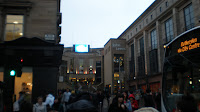
As I walked along Renfield Street, then onto Gordon Street, before turning into Buchanan Street, my eyes were actually peeled on the streets' surroundings. The buildings' look the same, but there are a lot of new shops now. Most glaringly, I noticed a few Starbucks outlets along the way.

As noted by my former Mathematics lecturer, Mrs Margaret Cunningham, the Starbucks outlets actually provided an option for people wanting to meet up with friends. In the past, people would go to local pubs or bars, but now people can opt for cafes like Starbucks.

While there have been changes, Glasgow still feels the same after 13 years.

[Pictures courtesy of Szakif Ramli].

Snow white

As far as I can remember, throughout my student days in Glasgow, it did not snow in December. Yes, there was snow but not in December. There was ice in December, perhaps even some sleet. Hailstones were more likely to come down in December. But I say it again, it did not snow in December. I remembered snow came down in February and March. Even then, the snow that came down did not last for long. Snow wasn't thick and it didn't stick.

A week before I arrived in the UK, I have been following the weather of the country. There has been a rather unusual weather pattern. The temperature has been coming down to levels that was somehow unexpected by meteorologists. And snow came down very heavily a few days before Christmas.

No snow came down on Christmas day when I arrived in London. When I travelled up north on the 27th, you could actually see snow on the ground. It is even more apparent as you go further north of Lancaster into Oxenholme and the Lake District. By the time you get to the Scottish border just after Carlisle, everything is literally snow white, from the hills to the grounds, as well as rooftops, and even cars were not spared from being covered in snow.

It was a beautiful sight to behold. Frankly, what I saw was nothing like the snow that I experienced in the first half decade of the 1990s. The snow still persisted on the day I travelled back south to London.

What a sight it was. Masya-Allah!

[Pictures courtesy of Szakif Ramli who accompanied me in this UK trip].